George Edmonds
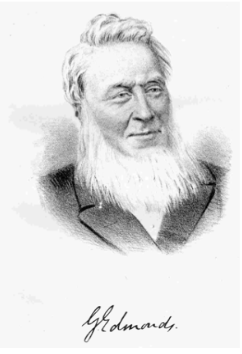 George Edmonds (1788 – 1868) was a scholar, publisher, social reformer, solicitor, Clerk of the Peace and Gentleman.
He was a native of Birmingham, born in Kenyon Street on 10th March 1788, the son of Baptist minister Edward and his wife Sarah Edmonds. In his early years George kept a school in Bond Street Birmingham, where his father was the Baptist minister. On 1st of October 1812, George married Patience Hancock at St Bartholomew’s Church in Edgbaston.
They had two children, son Horace born on 6th of May 1815 and daughter Clarissa born on 22nd of July 1819. Around this time George worked as a general agent from his premises in St. Luke’s Row, Constitution Hill. Later in his career he was a solicitor working from his home at 16 Whittall Street, Birmingham.
In the early 19th century political campaigning clubs were formed called Hampden Clubs. They used petitions and debates to bring about reforms instead of riots and violent protests. George Edmonds was the Chairman of the Birmingham Hampden Club and supported the reformer Thomas Attwood and his Birmingham Political Union. As a printing press owner George Edmonds was well positioned to produce his own pamphlets and distribute the Club’s political messages to the people of Birmingham. George also produced his own publications called “Edmonds’ Weekly Register”, “Edmonds’ Weekly Recorder” and “Saturday Advertiser”.
In January 1817 George Edmonds presided over a gathering of over ten thousand radicals on Newhall Hill. This was to be the first of many meetings there. Another meeting on the 12th of July 1819 called for Birmingham to get a seat in the House of Commons. This campaign failed and many were taken to court and sentenced. George Edmonds was found guilty of seditious conspiracy for publishing libelous material against the magistrates of Birmingham in his weekly Register. He was sentenced to nine months in Warwick Gaol. There were enthusiastic crowds in the Bull Ring to welcome him home when he was released.
George continued to fight for political reform, supporting Thomas Attwood. Finally in 1832, after “the great gatherings of the unions”, the Reform Act was passed granting two Members of Parliament to Birmingham. More reforms followed and Birmingham received its Charter of Incorporation and elected its first Town Council. The establishment of a Birmingham Borough Court followed and George Edmonds was elected Clerk of the Peace for the Quarter Sessions.
Alongside his political and legal callings George Edmonds was also a scholar. After working on the subject of a universal language for over forty years, George’s book entitled “A Universal Alphabet, Grammar and Language” was published in 1855. George Edmonds said he had spent “forty years’ wanderings in the wilderness of words”. This publication was thirty years before the invention of the more widely known international language of Esperanto.
George was widowed when Patience died on 9th September 1860, her death was “Deeply regretted by her family and friends.” She was buried in Key Hill Cemetery. After Patience’s death George remained at their family home in 16 Whittall Street, reducing his staff to just one house servant. Two years later at the age of 75 George was baptized into the Catholic faith on 27th of November 1863 at St. Peter’s Church on Broad Street. On 27th of July 1867, at the grand old age of 79, George married spinster Mary Fairfax at the parish Church in Leamington Priors.
Sadly by 1868 George was in “a declining and almost hopeless state of health, both physical and mental”. The last four months of his life were spent as a private patient in an institution called Abington Abbey in Northamptonshire. He died there on 1st of July 1868.
George was bought back to Birmingham by train to be laid to rest. The funeral procession started at the Queen’s Hotel by New Street Station and proceeded down Warstone Lane, to where George was buried at Birmingham General Cemetery at Key Hill. It was noted in the newspapers that a number of gentleman, including several members of the Birmingham Political Union, joined the procession of carriages to show their respect.
Recollecting George Edmonds, author Eliezer Edwards said he was “a man, who, sacrificing his own freedom, helped thereby to gain for his countrymen liberty of thought, liberty of speech, and liberty to carry on in the future the beneficent policy which he advocated with so much eloquence and perseverance”.
Sharon Stokes